Season 1: Key
“I hold the lock and you hold the key.”
Madonna, ‘Open your Heart’, True Blue, 1986, Warner Bros / Sire
A key is just an object unless there is something to be unlocked. Keys can be passwords, magical incantations, membership cards, bank cards, or even aspects of identity. Status, race, wealth, family lineage, or social position can all function as keys, granting access to spaces, opportunities, and knowledge.
Keys can symbolise both locking and unlocking, letting in and letting out. A key is a liminal object by design. It symbolises the threshold of something or somewhere.
It symbolises the tension between inside and outside, secrecy and revelation, innocence and knowledge, exclusion and belonging. Across myths, Gothic fiction and queer narratives, a key marks the moment when, like the bleeding key of the Bluebeard myth, we can no longer ignore what we have learned.
Reading the key queerly is to look at the politics of access - who holds the key, who gives one, who inherits one, and who is always locked out. This archetype also questions who built the door, who is given keys, and who was told they could never enter.
Light: This can be an exciting archetype that symbolises we’re on the threshold of something exciting, and we either already have the key or magic words to open the door, or we’ll receive it. It also could be knowledge or an important insight that you unlock.
Shadow: Keys are not politically neutral. Looking at this archetype queerly invites us to ask who controls access, who decides who may enter, and who is permitted to possess knowledge in the first place.
Origins
“Keys evoke the tension between seeking and finding, restricting and releasing, with holding and giving, prohibiting and admitting.” (1)
As an archetype, we can talk about a dizzying amount of ideas related to the key. Keys often represent ideas themselves! In English speaking countries we often say we have ‘the key’ when we have important information. In the past doors were more common in tombs than houses, so a door was more indicative of guarding something of spiritual value, and a key for unlocking it.
Because of this a key can symbolise secrets, thresholds, access to knowledge, and spiritual initiation. When there is a key, we wonder what it unlocks. A door, a diary, a tomb? And what happens when that door is open, or that secret is revealed? And what is a lock, or a locked door, box, etc, without a key to open it?
In Japan keys were traditionally a symbol of prosperity because they open the doors to the rice store. Rice is considered a spiritual food too, so the key gained spiritual initiation significance too.
“Sacred realms of death, rebirth and transformation have often been regarded as locked regions, protected by deities that protect the keys, or their priests and priestesses who mediate the initiate’s entry into the divine mysteries.” (2)
Keys feature heavily in mythology and religions involving an afterlife. St Peter in the Christian Bible was given the keys to heaven by Jesus, and in the Qua’ran, Shahada is the key to paradise, but in the form of four words which represent four teeth of the key. Roman God Janus is symbolised by two keys, one silver and one gold, representing light and darkness. In Pagan communities, keys open the solstices, and the turning of the wheel of the year.
In folklore, keys, whether shaped as a traditional key or symbolically, can appear as a tool of initiation. They often appear in threes- whether that’s unlocking three stages, rooms or enclosures, or completing three tasks.
Examples in media
Blackbeard myth - Women who Run with the Wolves by Clarissa Pinkola Estes and The Bloody Chamber by Angela Carter
Dracula - Bram Stoker
Flowers in the Attic - Virginia Andrews
The Monk - Matthew Lewis
The Grand Budapest Hotel
Pillion
Queer as Folk (UK)
Pan’s Labyrinth
Buffy the Vampire Slayer
Mulholland Drive
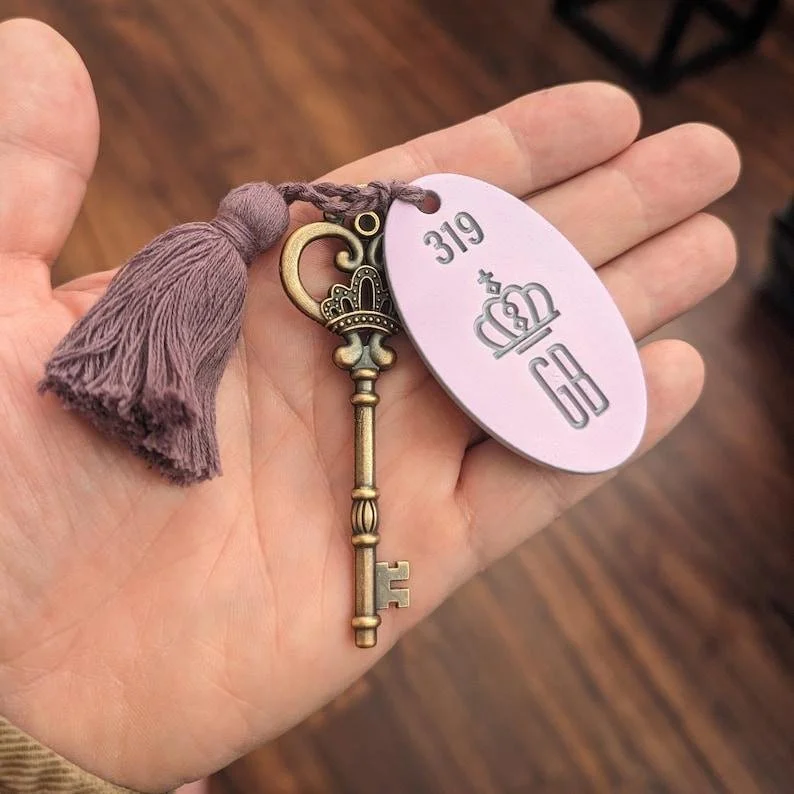
Key from The Grand Budapest Hotel
Queer & Uncanny analysis
Queer Coming of age and identity thresholds
Because keys exist at thresholds, they naturally appear in stories of transformation. Queer coming-of-age narratives in particular are full of symbolic keys: objects, documents, and people that grant access to new identities and communities.
Keys are an archetype that exist in the liminal, which is a space between binaries such as in or out, up or down. Think of it like a space we pass through on the way to somewhere else, or someone else. But it is a place in itself.
Liminal stories can be any story where someone goes through a rite of passage, such as puberty, marriage, birth, losing a job, or losing a parent etc. Whenever we are on the threshold of becoming a different person, or stepping into a new life stage. Keys can feature in different forms, such as a key to a new home, an ID card for a new job, a change of name on a legal document.
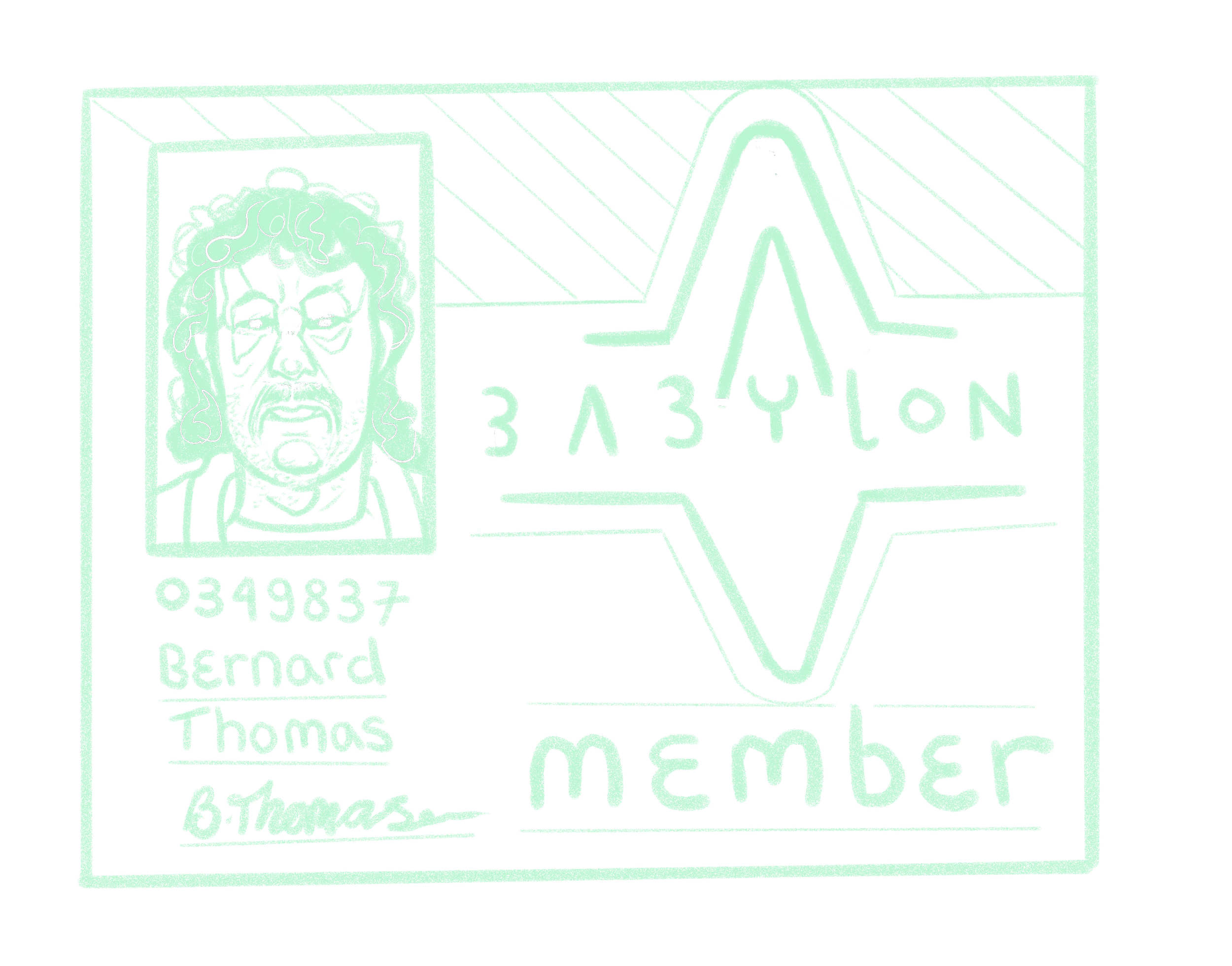
To look at this queerly we can look at rites of passage that involve keys, which includes the very common queer coming out story. In queer lives, crossing a threshold is rarely automatic. In the British series Queer as Folk, young man Nathan uses an inherited membership card to gain entry to his first gay clubs on the Manchester gay scene. (3) The membership card functions symbolically as a key and gets him over the threshold and initiated into this new world.
For Nathan, the Manchester gay scene already exists, and he at least knows where it is, and he can reach it by bus. But even then he doesn’t know which bars are safe to go into, who to talk to, befriend, or who is safe to go home with. The scene is its own culture with rules. As Nathan is underage, one issue for him is even gaining access to a particular club. Though an older man, recognising the situation Nathan is in, helps our hero over the threshold.
Many of queer milestone stories also feature leaving a home of family that doesn’t support their identity, leaving to find like minded community, first entering that community and finding chosen family, and discovering identity, for example, a person may realise they’re trans or non-binary, and start transitioning or changing their social presentation.

Still from Pillion.
Recent queer British film Pillion is a poignant and different take on the coming of age genre (4). Young man, Colin, enters a closed society of bikers who enjoy BDSM dynamics. Colin is on a journey of self discovery, and during the film he matures sexually and emotionally.
Colin’s dominant and lover, Ray, carries the key for his lover’s collar around his neck.
Colin’s collar with the big metal lock symbolises their BDSM arrangement, and Ray has the power to remove the collar. Symbolically, the oversized size of Colin’s lock may represent his oversized “aptitude for devotion.”
Colin’s parents are very accepting of Colin’s sexuality, and keen for their son to meet a nice young man, but are hesitant and judgmental of the kind of relationship Colin finds himself in. Colin must come out again to his parents, and assert what he wants.
Ray tells Colin’s Mum:
“It’s not for you to like.”
By the end of the film Colin is more sure of what he wants and needs, and is empowered to manage this with future lovers. In the film he is last seen creating boundaries with a potential lover- he is now the one controlling access based on his own needs and desires.
As we can see, thresholds are not always physical doors. In stories where a character is on the threshold of a new identity, keys can symbolise psychological change as much as physical. In Gothic fiction, sometimes a terrifying locked attic or basement can represent the psychological.
If coming of age is about finding the key, initiation is about discovering what waits behind the door. And that thump thump thump we hear might be trying to tell us something about ourselves- if we survive it, that is.
Hidden Knowledge, Locked Rooms & Initiation
“[…] the ‘locked room’ of many fairy tales, reflecting the psyche’s defended spaces nevertheless bids one to key in to what it conceals of possibility, and danger. Unlocked, such rooms reveal treasure, secrets, dismembered bodies, demons, captives- or nothing at all.” (5)
Throughout folklore, Gothic fiction and fairy tales, locked rooms conceal forbidden knowledge, and the act of unlocking these doors becomes a rite of initiation. It’s rarely questioned if a door should be opened, rather the question becomes can we can forget what we find inside?
Keys can represent gaining knowledge, often secret or otherwise valuable, as the key is a way to unlock hidden information or locked rooms containing secrets.
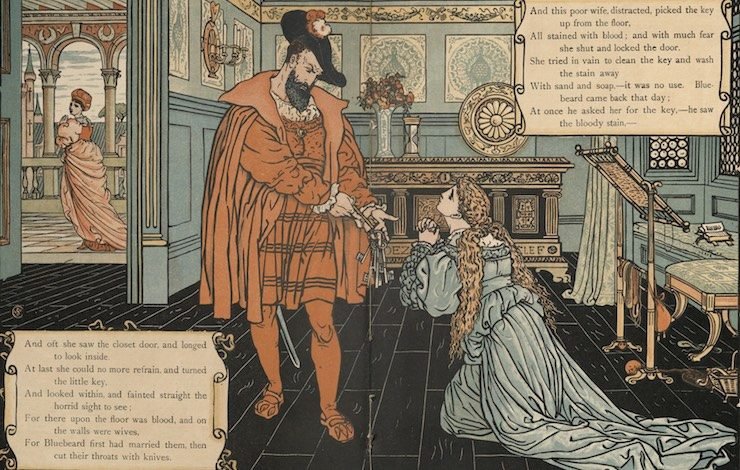
Bluebeard Illustration by Walter Crane
The Bluebeard myth, which differs in details across retellings, is about a young woman who agrees to marry a rich man, who has a beard that is somewhat blue. He takes his new wife to a large and isolated gothic home, and one day leaves her at home with a set of keys while he goes abroad for a trip. One of the keys opens a room in the castle/home where the bodies of his previous wives are lying there mutilated and bloody.
In Women who Run with the Wolves, Clarissa Pinkola Estes provides a retelling of the Bluebeard myth passed down in her culture through spoken word. In her retelling Bluebeard gives his wife a big ring of keys that open every room in the big castle they live in:
“You may do anything […] your heart desires. In fact, here is my ring of keys. You may open any and every door to the storerooms, the money rooms, any door in the castle; but this tiny key, the one with the scrollwork on top, do not use.” (6)
When she finds the room of bodies and blood, the wife tries to wipe the small key clean on her gown. But the key is stained red with blood and even continues bleeding, and it gives her away to her husband.
The key in the story represents both knowledge and secrets that the life needs to stay alive. Bluebeard tells his wife she can have all the freedom in the world, just not that one door and key that opens it.
Estes invites us to look at the Bluebeard myth as a metaphoric story happening in a woman’s psyche. The key is self knowledge and intuition, which we all need to keep ourselves safe from predators. “Finding the little door [of the locked room/bloody chamber] is important, disobeying the predator’s order is important, and finding out what is so special about this one room is essential.” (7)
At an instinctual level of the psyche, what goes thump in the basement of our psyche needs “attending to, or requires arrest.” (8)
“I just have a key and I don’t know which door it fits,” the wife says in the story, and it’s that little question, the niggling thought that there is something, that can be a key that opens a locked door somewhere (9). It can be clues in your every day life, something feeling off, something about the heterosexual culture we’re all presented with that doesn’t feel like it fits. The question itself is a little beacon, like something pinging in our intuition, even if we don’t know what we’re being called towards.
Magic doors often require a key in the form of a correct phrase, or question. “The key question causes germination of consciousness. The properly shaped question always emanates from an essential curiosity about what stands behind. Questions are keys that cause the secret doors of the psyche to swing open. In the Eleusinian mysteries, they key was hidden on the tongue as key questions or a special set of words.
We won’t always find a dramatic bloody chamber behind a locked door, but as this is an archetypal story full of symbolism and metaphor, blood symbolically often represent passion and life force. The key in the Bluebeard myth bleeds because:
“Once we have seen the shocking truth of the killing room, we can no longer pretend it doesn’t exist. […] If there is a forbidden something, it needs looking into.” (10)
Blood is very often part of initiation rites- and can be a key in itself that allows a character to move over a threshold, or through a magic door.
The bleeding key is a loss of innocence, or naivety. Estes tells us that the blood in this story is not menstrual, but arterial. Once the knowledge is revealed, we can’t go back to pretending everything is ok and that the carnage doesn’t exist. It is a “crying question.” (11) The bleeding is a wound that can’t be healed. Blood symbolises life itself, and the bleeding is the draining of life force.
In Sleeping Beauty, the princess pricks her finger on a sewing loom, drawing blood, and this sends her into a comatose state until a prince fights his way through to her and kisses her to wake her up.
In TV show Buffy the Vampire Slayer, a secret society of monks Buffy give a key that opens portals. (12) They give it to her for safe keeping because of her reputation as a warrior. They even transform the key into a human in the form of a little sister, Dawn, so she will protect it with her life.
Dawn is now blood related to Buffy like a real sister. In a finale episode, enemy Glory uses Dawn’s blood to open a portal to a hell dimension, as Dawn is still the embodiment of a real key, so it’s now her blood that opens things. But in a fun twist, because of the monk’s spell, Buffy can use her own blood to close the portal. Effectively using herself as a key to lock the door!
That Buffy inherits the blood connection is also interesting, more so because Dawn could be placed into the category of found family, that she and Buffy found each other. Inheritance itself is a gothic novel trope that I’ll talk about later on.
In Pan’s Labyrinth, protagonist Ofelia’s birthright is Princess of the Underworld. She is given a series of initiative tasks by a larger than life talking Fawn to unlock her access to the Underworld kingdom, and to crown her as Princess. (13)
The final task the Fawn gives her is to kill her baby brother, spilling “the blood of an innocent” to open the door to the Underworld. She refuses, and is shot by another character. Her blood then opens the door and completes her initiation.
The children of the novel Flowers in the Attic by Virginia Andrews remain locked in the attic of a grand house for three years so their Mother can reconnect with her father and win back her inheritance. Unlocking the house exposes not only hidden wealth but forbidden knowledge, discovering pornography, family secrets and their own taboo desires. Like Bluebeard’s chamber, the unlocked rooms reveal truths that cannot be unseen.
“We had a key. We could open our prison door. Yet strangely, we hadn’t planned our future beyond the opening of the door.” (14)
When the teenagers explore the large and grand house owned by their grandfather, they find a ‘trophy room’ full of the heads of dead animals, tiger and bear skins on the floor, reminiscent of the room of human bodies in the Bluebeard myth. Then in the opulent bedroom that their mother shares with her new husband, they also find many furs and minks of dead animals.
To the teenagers, the forbidden things they’re hiding from is attraction to each other, after being locked up with no other options during puberty. The bodies symbolise what they’re repressing.
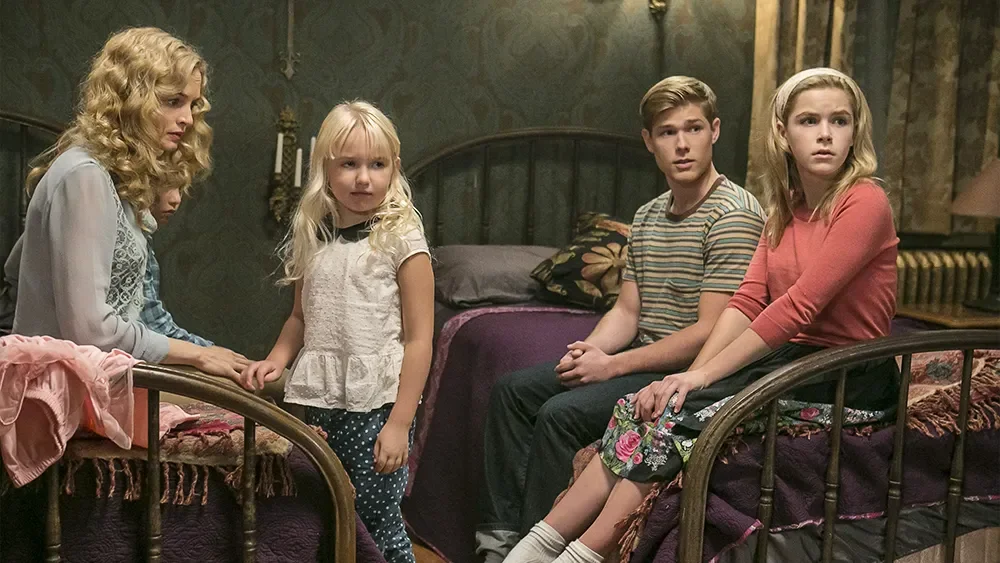
Still from the Flowers in the Attic Lifetime adaptation.
To make the connection more obvious, as well as money and fine clothes, the teenagers also find a book full of pornographic images in a nightstand. Cathy muses:
“Why I believed [sex] was a sacred, reverent thing to do, in complete privacy, behind locked doors. […] I couldn’t move, couldn’t leave, couldn’t close that book without pursuing it cover to cover.” (15)
Christopher is also fascinated by the book, making multiple risky trips downstairs to read it:
“It was that book in the nightstand drawer that drew him always; it lured him, beckoned to him, was to shipwreck him later, and me too.” (16)
The room, and the book that they find by using the wooden key become information they can’t ignore. A nagging question, which ultimately leads to tragedy as Chris rapes his sister, Cathy.
Angela Carter’s retelling of the Bluebeard myth was published in her short story collection of the same name, The Bloody Chamber. (17)
The key in both Angela Carter’s The Bloody Chamber and Estes’s Bluebeard retelling bleeds after it unlocks a door, juxtaposing the bloodstain on the sheets after the young wife loses her virginity to her husband.
It is very heteronormative to think that virginity can be lost in the first place, or is only lost when a penis penetrates a vagina. That it is only the vagina that can be wounded, or changed irrevocably. It’s more useful to look at it symbolically.
The image of a phallic object such as a key bleeding is much queerer. In Carter’s Bloody Chamber, the bleeding is a sign that the genie can’t go back in the bottle. Knowledge once gained cannot be lost. Both protagonists cannot return to ignorance, and must confront that reality of their murderous husband. Innocence has been lost, but knowledge has taken it’s place.
When we think of the image of a locked room in relation to queer lives, the closet is an obvious example. An archetype itself, the closet is a metaphoric, emotional and political space where queer people often reside out of fear and self preservation. When we think of a locked room such as a closet as a room in our psyche, like any other person, a queer person may feel the same instinct that they’re not acknowledging part of themselves, that is empirical as their life blood, in their own bloody chamber.
But politically, queer people are already in the locked room of the closet, whether they’re aware of their identity or not:
“Even at an individual level, there are remarkably few of even the most openly gay people who are not deliberately in the closet with someone personally or economically or institutionally important to them.” (18)
Many queer people are unable to stay inside the closet because of their mannerisms, appearance or something else about their person.
Sedgwick then goes on to explore the way that physical and cultural space that queer people occupy has been mapped in a way that the closet becomes “a defining structure for gay oppression in this century.” (19) She explores court cases in which the courts struggled to decide if it was more appropriate for a gay person to disclose their identity in public spaces, or to stay in the closet.
That the closet has damaging contradictions of what it means to be in and out of the closet, publicly and privately. Many public figures, though afforded space inside a kind of glass closet, are still at the mercy of tabloids and people speculating on their sexuality.
The “closet” and “coming out” now verging on all-purpose phrases for the potent crossing and recrossing of almost any politically charged lines of representation. (20)
For other queer people, having access to knowledge or communities to safely explore their identity is a privilege, though it may come as pure luck of being born into a supportive family, community, or purely geographically they have access to affirming queer community. Like the membership card from Queer as Folk, sometimes we need to be given a key.
Hidden knowledge is rarely hidden by accident. Someone decides what remains locked away, who may enter, and who must remain outside. Once we begin asking who holds the key, this archetype becomes unmistakably political.
Secret Societies & Inheritance
Keys are never politically neutral. Some people are given them because they’re the right kind of people, some people inherit them, some are denied them, and many people never know they exist. Whether in secret societies, families or queer communities, keys reveal that access is often decided long before an individual requests access.
Queer people have often had to control information for their own safety and happiness, and people that live in unsupportive families and societies still do.
Carabiners, metal clips that hold keys together safely and clip onto a wallet, belt loop or bag, have long been used as a queer symbol. They became popular in lesbian communities during the rise of butch culture in the 1980s. (21) Women wore them on on a specific side and location to indicate sexual preference and to announce themselves to fellow lesbians in a time when it wasn’t always safe to wear pride T-shirts and other apparel we see today.
And then there are more nefarious secrets. In film Mulholland Drive, protagonist Betty seemingly pays a hitman to assassinate her ex-girlfriend (22). The hitman says he’ll leave a blue coloured key when the job is complete, and we do see it in her house later. In this way the key is left as an enigmatic token to let Betty know the job was done, and represents the knowledge that her ex girlfriend is dead:
“…the blue key represents an ugly certainty... we do know what it signifies.” (23)
It’s unusual that the normal looking key is entirely blue, especially that during the film we also see another blue key, this time a strange futuristic key that matches a blue box. In a dream-like sequence the box is opened and two old people we saw earlier in the movie come out and seemingly cause Betty to shoot herself. Many essays link the blue box and key to Betty’s guilt. It’s also common to hear that the blue keys are both threshold objects, taking the characters from one psychological or dream state to another.
Lynch famously never told us what the film means (24), but a video essay by YouTube channel Twin Perfect has suggested that the blue key(s) and box represent the culture of silence around the casting couch in Hollywood (25). The colour symbology of the keys, box, and the recurring blue motifs such as he singers hair, and her singing with no voice, at Club Silencio support the theory. Even that it is ‘Club’ Silencio, suggesting a group of people united over a particular interest.
The video essay includes an interview clip of Lynch talking about his feelings about the casting couch. That Mulholland Drive is all about Hollywood culture, it makes sense to look at the video as being about the shame and silence around the couch. The blue box itself reminiscent of Pandora’s box, containing terrible things that we keep locked away from polite society. As Mulholland Drive is an explicitly queer film, we can also read into this culture of silence queerly- how many actors in the golden age of Hollywood, and even today- feel as though they have to stay in the closet for the sake of their careers?
The keys in The Grand Budapest Hotel are much less discussed by academics than the blue key in Mulholland Drive. M. Gustave, the manager of the Grand Budapest Hotel, is a key holder, and the key also admits him into a secretive society of hoteliers. (26) The membership keys are beautiful and ornate, with engravings and even tassels. They allow safe passage and access for the owners of hotels, and the sharing of resources. This membership all the more poignant within the context the film is set in- the brutality and fascism invading Europe prior to the World War II.
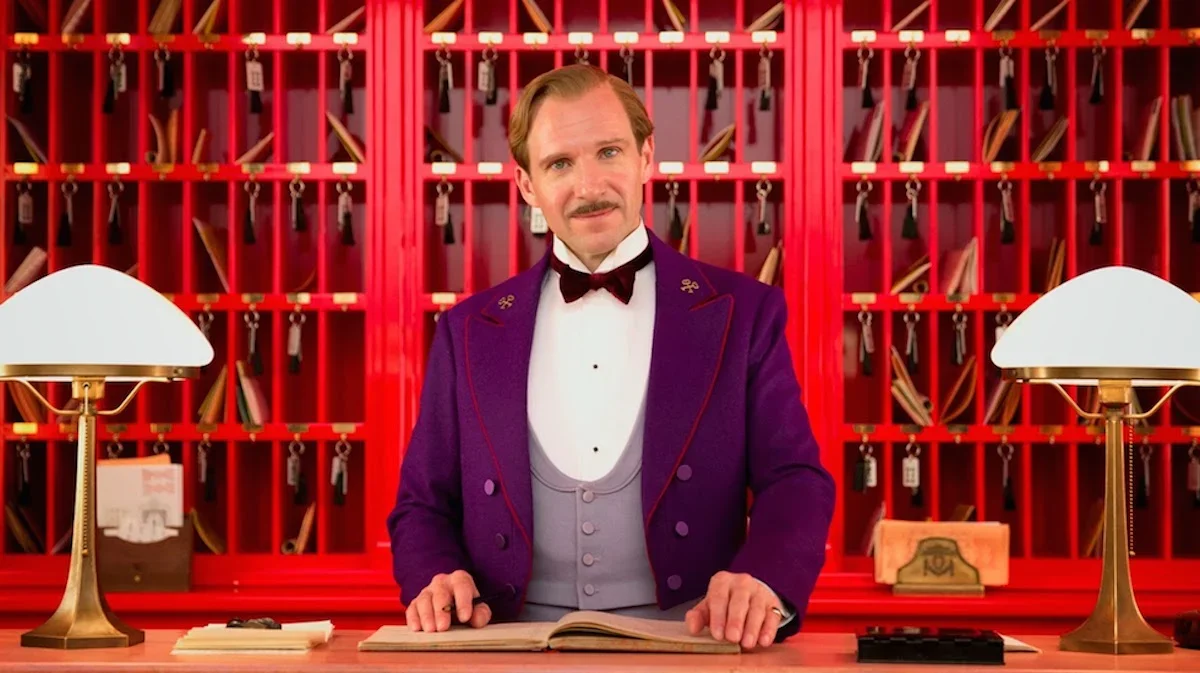
Still from The Grand Budapest Hotel.
M. Gustave, who himself inherited the hotel, then passes the stewardship of the hotel down to bellboy Zero, passing him the keys to not only every room, the hotel itself, but also to the mysterious society of hoteliers, transforming the hotel keys into symbols of belonging and mutual care.
This inheritance evokes a feeling of found family, and inheritance between people who are not blood related, but who have found each other nonetheless. Metaphorically we could read this as passing down of queer spaces and history.
When we talk about inheritance it’s important we also talk about disinheritance. Many queer people are disowned from family structures and disinherited from generational wealth because of their identities.
In the Flowers in the Attic, the children are locked away until their frail, wealthy grandfather dies and their mother can be re-inherited:
“He is sixty-six years old, and he is dying of heart disease […] your Grandfather can’t possibly live more than two of three months longer at least […] -and when he dies, his entire fortune will be mine!” (27)
It’s not just the wealth and inheritance that is locked away from the children- it’s their healthy sexuality. The infamously strange novel is as much about the sexual awakening of Cathy and Christopher, the two oldest siblings. The two teenagers start to have sexual feelings for each other because they’re trapped together with no-one appropriate they can direct their feelings toward.
Following the same theme, Cathy goes down to her Mother’s bedroom alone and finds her mother’s new husband, Bart, asleep in the bedroom on a chair, and kisses him. Cathy is sexually repressed and longing for an appropriate person to desire, Bart symbolises another key that has been denied:
“A secret. How well she could keep such an important secret!” (28)
The moment is subtly queered as a gender swap of the kiss is Sleeping Beauty. Cathy’s first kiss is one she steals without consent.
“Now I had all the answers,” Cathy muses after Christopher rapes her in the attic. (29) Rather than wealth, what they’ve actually inherited is a legacy of incest and secrets.
Access is not only structural, but it can also be deeply personal, as we navigate intimacy, desire, and how and who we choose to share our bodies with one another.
Sexual Motifs
‘A man may dream of inserting a key in a lock, of wielding a heavy stick, or of breaking down a door with a battering ram. Each of these can be regarded as a sexual allegory. But the fact that his unconscious for its own purposes has chosen one of these specific images it may be the key the stick, or the battering ram is also of major significance. The real task is to understand why the key has been preferred to the stick, or the stick to the ram. And sometimes this might even lead one to discover that it is not the sexual act at all that is represented, but some quite different psychological point.’ (30)
As Madonna sang in the suggestive Open your Heart, she has the lock and her lover has the key.
Few symbolic pairings are as culturally recognisable as keys and locks. Reducing them to a simple metaphor for heterosexual penetration is too simplistic. Read queerly, the key becomes a symbol, not just of sexual intercourse, but of intimacy, vulnerability, consent, curiosity and transformation.
Keys when associated with locks have long been a symbol of sexual intercourse due to their resemblance to a penis entering an orifice:
‘A key in a lock may be a sexual symbol — but not invariably. […] No individual symbolic image can be said to have a dogmatically fixed, generalized meaning.’ (31)
To disagree with Jung, I have an undergraduate degree in film. In the psychoanalytic tradition in film studies, ordinary props that are particularly tall, upright objects- lamps are often used an example- can be read as phallic symbols that symbolise sexual tension between two characters. (32) Flashlights are another such object- and the fact characters use them while exploring dark places… the analysis writes itself.
But why is everything considered a penis? One answer is that we live in a world full of the male gaze, where woman centered media is either not made, or devalued as trivial, or melodrama. It’s interesting that Pandora’s jar, more commonly described as a box, is symbolically womblike. Where something far larger than could be thought to fit inside it, comes out, like a child?
So keys and locks may be a suggestive symbol for penetrative intercourse, and not everyone enjoys penetrative sex, and not everyone wants to engage in physical sex. There is also a heterosexual suggestion that the lock must be female, a vagina, an anus, or orifice that belongs to a receptive partner. The person holding the key, be it a penis, a sex toy, is doing the penetrating, is the one unlocking the knowledge.
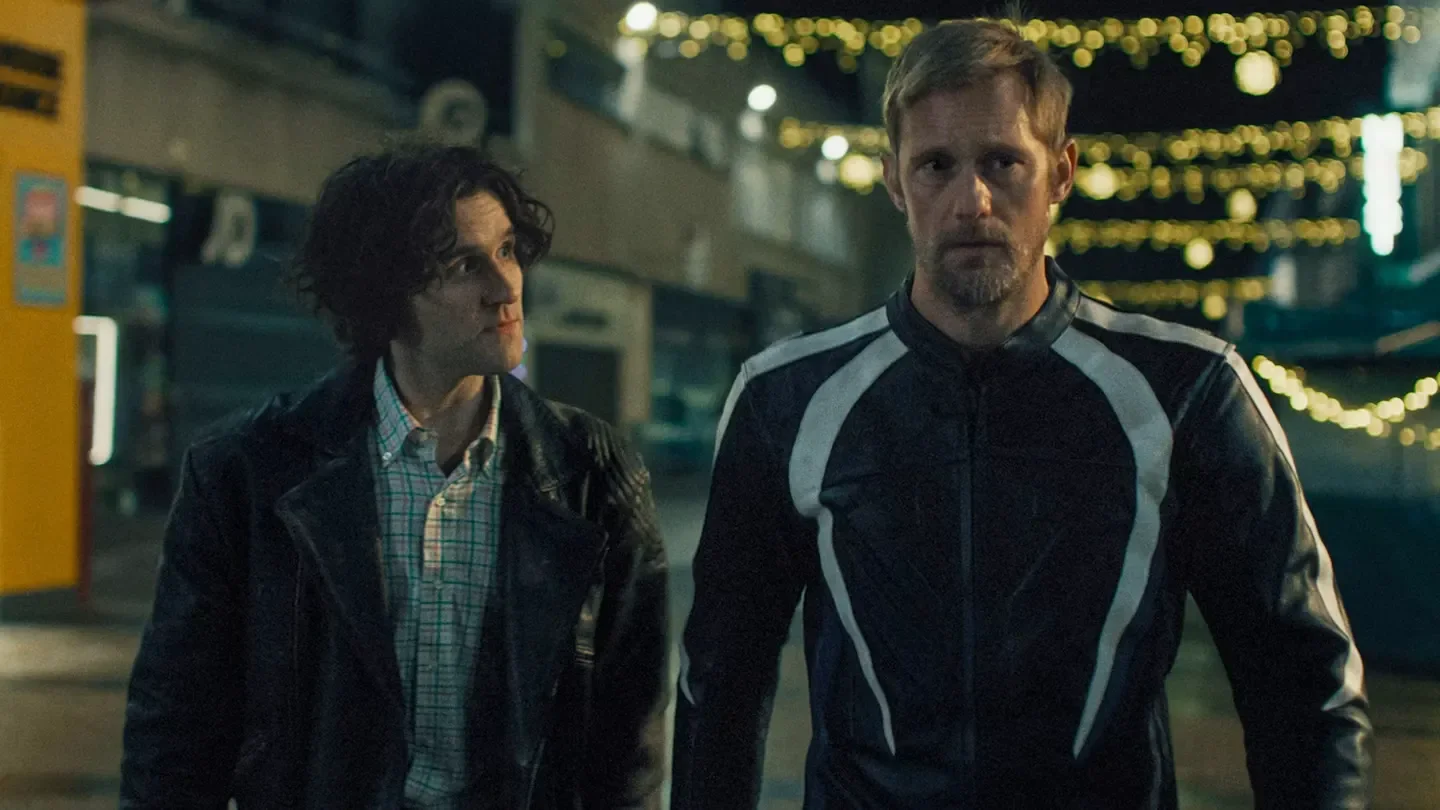
Still from Pillion.
Coming back to Pillion, Colin holds the lock and is unlocked, and penetrated, but it is he that has the character growth and confidence to explore himself and be opened to new experiences. Ray has certainly facilitated this expansion, but Colin steps into his own confidence and agency, and asserts his desires. We could say that Colin fails to ‘unlock’ Ray, who is determined to stay closed to a new dynamic, or he does succeed, but Ray is unwilling to change.
In another BDSM romance film, Secretary, Mr Grey unlocks Lee’s desires. He functions as a key by giving her permission to do things for herself like walking home from work. She feels “held by him as she walks.”(33)
“See, people are like locked rooms. They’ve all got different locks and you’ve got to guess the shape of their key. […] So if you want someone to open a door, you have to try out different keys until you find one that works.” (34)
Master keys, also known as skeleton keys, as a symbol are powerful in that they can potentially open any door. It can a symbol of a persons privilege, being able to access any part of life they want, be it physical locations, closed communities and societies, knowledge, wealth. It is also very queer to be or own a master key, as the implication is that the key will fit any lock.
Whether opening a cellar door, or entering a queer community, inheriting hidden wealth or beginning an intimate relationship, the key marks the same archetypal moment of crossing thresholds. And once crossed, we’re never quite the same.
Associated Archetypes
The Liminal / The Bardo
Door / Gateway
Blood
The Predator
Beard
Bones
Cellar / Basement
Footnotes
(1) Ami Ronnberg and Kathleen Martin (eds.), The Book of Symbols: Reflections on Archetypal Images (Cologne: Taschen, 2010), pg 562.
(2) Ronnberg and Martin, The Book of Symbols, pg 562.
(3) Queer as Folk, created by Russell T Davies, Season 1, Episode 1, Channel 4, 1999.
(4) Pillion, directed by Harry Lighton (Element Pictures/BBC Film, 2025).
(5) Ronnberg and Martin, The Book of Symbols, pg 562.
(6) Clarissa Pinkola Estés, Women Who Run With the Wolves (London: Rider, 1992), pg 44–45.
(7) Estés, Women Who Run With the Wolves, pg 48.
(8) Ronnberg and Martin, The Book of Symbols, pg 562.
(9) Estés, Women Who Run With the Wolves, pg 48.
(10) Estés, Women Who Run With the Wolves, pg 51.
(11) Estés, Women Who Run With the Wolves, pg 51.
(12) Buffy the Vampire Slayer, Season 5, Episode 5, "No Place Like Home," directed by David Solomon, written by Douglas Petrie, originally aired October 24, 2000.
(13) Pan's Labyrinth, directed by Guillermo del Toro (Estudios Picasso/Tequila Gang, 2006).
(14) V. C. Andrews, Flowers in the Attic (New York: Pocket Books, 1979), pg 309.
(15) Andrews, Flowers in the Attic, pg 316.
(16) Andrews, Flowers in the Attic, pg 327.
(17) Angela Carter, The Bloody Chamber and Other Stories (Vintage, 2006), pg 30.
(18) Eve Kosofsky Sedgwick, Epistemology of the Closet (Berkeley: University of California Press, 1990), pg 67–68.
(19) Sedgwick, Epistemology of the Closet, pg 71.
(20) Sedgwick, Epistemology of the Closet, pg 71.
(21) Joseph, "A Brief History of Keys," Object Studies, March 6, 2023, https://objectstudies.net/2023/03/06/a-brief-history-of-keys/.
(22) Mulholland Drive (stylised onscreen as Mulholland Dr.), written and directed by David Lynch (Universal Pictures, 2001)
(23) Marina Soler, Jorge, "Scholarly Distinction and Mulholland Drive: Notes about Film Criticism," The International Journal of Arts Theory and History 10, no. 2 (2015): pg 29–38, https://doi.org/10.18848/2326-9952/CGP/v10i02/36277
(24) Chris Rodley (ed.), Lynch on Lynch (London: Faber & Faber, 2005).
(25) Twin Perfect, The Terrible Secret of Mulholland Drive, YouTube video, 2:25:09, September 27, 2020, https://www.youtube.com/watch?v=OiCfHW3N3vo
(26) The Grand Budapest Hotel, directed by Wes Anderson (Fox Searchlight Pictures, 2014).
(27) Andrews, Flowers in the Attic, pg 30.
(28) Andrews, Flowers in the Attic, pg 321.
(29) Andrews, Flowers in the Attic, pg ?.
(30) C. G. Jung, Man and His Symbols (London: Aldus Books, 1964), pg 30.
(31) C. G. Jung, Man and His Symbols (London: Aldus Books, 1964), pg 30.
(32) I came across this concept in an introduction to film textbook that discussed mise-en-scène, where objects often take on symbolic expressions of unconscious desire. The textbook quoted Christian Metz, and Metz does touch on this subject in his book, The Imaginary Signifier: Psychoanalysis and the Cinema, trans. Celia Britton et al. (Bloomington: Indiana University Press, 1982).
(33) Secretary, directed by Steven Shainberg, screenplay by Erin Cressida Wilson, based on the short story by Mary Gaitskill (Lions Gate Films, 2002).
(34) The Haunting of Bly Manor, created by Mike Flanagan, Season 1, Episode 3, "The Two Faces, Part One," released October 9, 2020, Netflix.
Bibliography / Reading lists
Below are key texts and articles that I found particularly important that you may want to pick up and read for further information on the topics.
You can find my ongoing Queer Uncanny reading lists here.
Keys:
Clarissa Pinkola Estés, Women Who Run With the Wolves (London: Rider, 1992) (fantastic book- Estés is a Jungian Psychologist and feminist story keeper. I love how she deconstructs fairytales and folklore)
Angela Carter, The Bloody Chamber and Other Stories (Vintage, 2006)
(Amazing retelling of the Bluebeard myth. The other stories in the book are also great)
Eve Kosofsky Sedgwick, Epistemology of the Closet (Berkeley: University of California Press, 1990) (Meaty text about the politics of the closet. A wonderful mix of history and literary analysis. This is a very dense text, but the introduction and the first chapter are really insightful and lay out her main points.)
Marina Soler, Jorge, "Scholarly Distinction and Mulholland Drive: Notes about Film Criticism," The International Journal of Arts Theory and History 10, no. 2 (2015) https://doi.org/10.18848/2326-9952/CGP/v10i02/36277
David Lynch, “10 Clues to Unlocking This Thriller,” originally prepared for the French release of Mulholland Drive (2001). Reproduced in the DVD booklet and subsequent home-video editions. (You’ll find this in the DVD sleeve of the film)
Campora, Matthew. “Chapter 4. Mulholland Drive.” In Subjective Realist Cinema: From Expressionism to Inception, 68–93. New York: Berghahn Books, 2014. https://doi.org/10.1515/9781782382799-006 (Campora had some interesting thigns to say about the films symbology)
Arnold van Gennep, The Rites of Passage, trans. Monika B. Vizedom and Gabrielle L. Caffee (Chicago: University of Chicago Press, 1960 [1909]). (Gennep argues that rites of passage consist of three phases: separation, transition (liminality), and incorporation)
Michel Foucault, Discipline and Punish, trans. Alan Sheridan (London: Penguin, 1977). (Foucault is a fantastic foundation for understanding Queer Theory, and in this book he explores the relationship between power and knowledge.)
Michel Foucault, The Archaeology of Knowledge (London: Routledge, 2002 [1969]). (He also has some interesting takes about knowledge keeping, such as institutions maintain authority by regulating who has access to knowledge and who may speak with authority. )
Jack Halberstam, In a Queer Time and Place (New York: NYU Press, 2005). (also a fantastic foundational queer theory book. Halberstam argues that queer lives frequently follow alternative timelines that diverge from conventional milestones.)
Sara Ahmed, Queer Phenomenology (Durham: Duke University Press, 2006). (Also a dense book- I found it easier once I’d read a few foundational articles about phenomenology and queer theory before I dived in to this one. Ahmed suggests that sexual and romantic orientation is not only spatial but social. Bodies physically ands emotionally orient toward some spaces while being excluded from others. )
Illustration notes
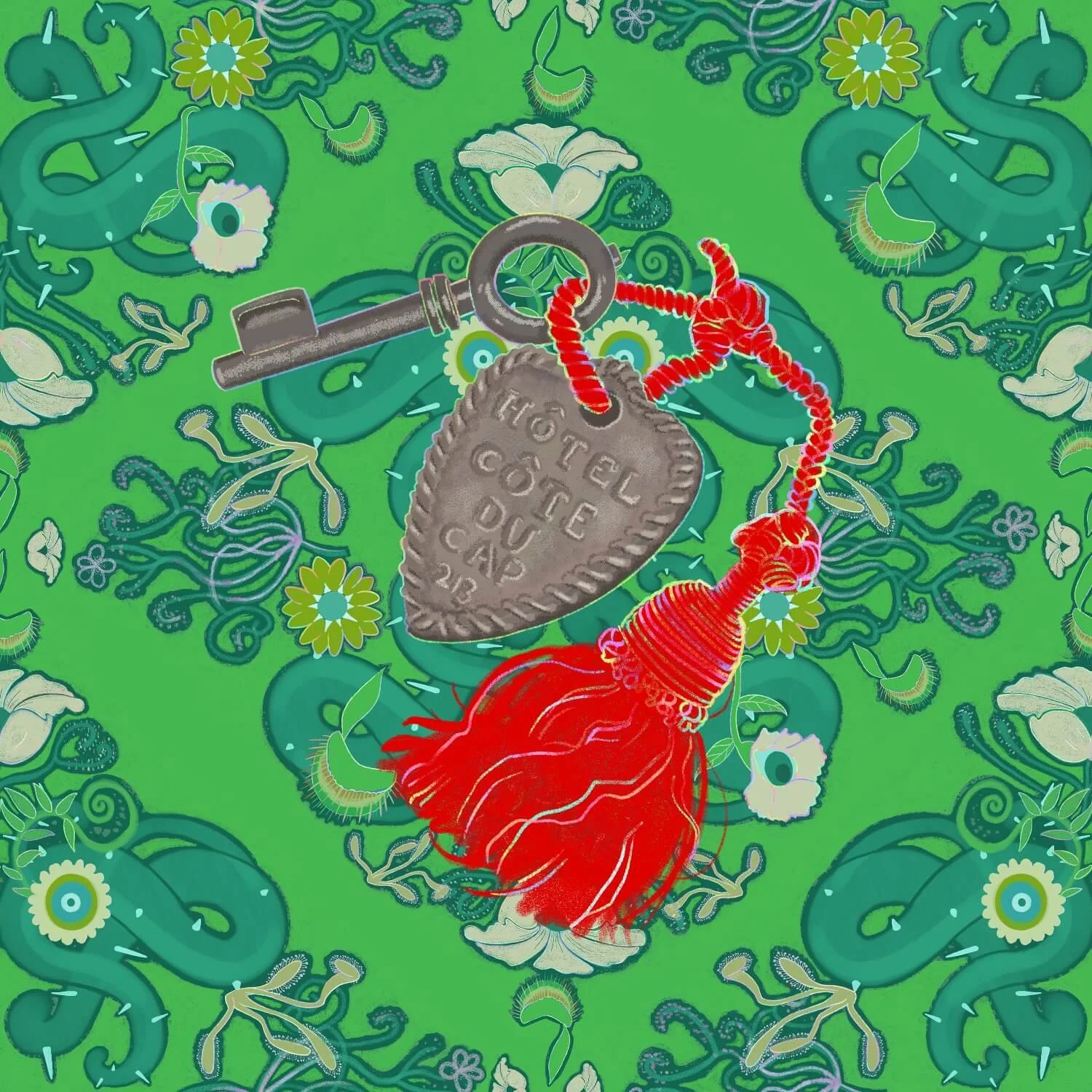
The key I’ve drawn for this month is from the Grand Budapest Hotel. I saw many of the keys in person at the Wes Anderson Archive exhibiton at the Design Museum this year, and I loved them.
Each key from the film is as ornate and elaborate as the hotel they represent. They just seem top represent the glamour of the past, with their ornate metal engraved handles and colourful tassels.