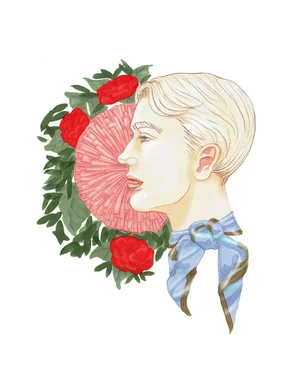
"'Cause I could do anything I want and instead, I choose to pout and whine and feel the burden of Slayerness? […] I could squeeze you until you popped like warm champagne and you'd beg me to hurt you a little bit more. And you know why I don't...? Because it's wrong."
-Faith (as Buffy), Buffy the Vampire Slayer, “Who Are You?” (1)
Introduction
The Possessed is someone who has found themselves host to an invading entity or parasite, such as a ghost or an alien. Like being haunted, being possessed can be terrifying because it plays on a deep fear we have about losing control of ourselves to a strange other, and even being replaced.
The mysterious Sheep entity of Murakami’s Wild Sheep Chase chooses to enter a human host as a spiritual communion, but sometimes leaves its hosts ‘sheepless’ and broken. (2) Some parasites are aliens, ghosts, creatures, daemons and occasionally the devil itself. Many parasites just want control of the hosts body, like the Sheep entity, and some want to replace the host, like Adele in Behind our Eyes (3). And some want to destroy us completely, like in classic movie Alien.
But what does it mean to lose our identity and personal boundaries? Are we still ourselves if someone or something has control of our mind or body? What if we still look and sound like ourselves, but are no longer entirely us?
No matter how we’re invaded, it’s our identity itself that’s under threat. And the body can become a battleground for control of our own autonomy.
Light: A possession can sometimes show us what secret desires we’ve been repressing. You can embody this archetype positively by trying on a new identity, whether that means wearing something that feels daring, or saying yes to something that’s normally outside your comfort zone.
Shadow: This archetype can warn us of losing ourselves to someone else’s agenda or belief system, or assimilating to a majority culture. Take up space and practice setting boundaries, when safe to do so. If not safe, keep a record of your true self and history.
Origins
“Pinch myself and say I AM AWAKE once an hour. Look at my hands. Count my fingers. Look at clock (or watch), look away, look back. Stay calm and focused. Think of a door.”
Rob/Adele, Behind Her Eyes (3)
The Possessed has a lot in common with The Shapeshifter because they are both archetypes that involve some sort of identity transformation. The Possessed are specifically hosts to some kind of invading force, whether the force was invited in or not. Shapeshifters, like possessed people, may lose control of their body due to external influence. Possessions turn up time and again in gothic and horror media due to our primal fear of being invaded by an external force.
Concepts of possessions and shapeshifters have been part of our cultural imagination for centuries. In their book Shapeshifters: a history, author Kachura argues that our modern societies have largely lost the ‘intimate connection’ to the animal world, one that used to mean life or death.(4) Prehistoric societies recognised that they needed to compete with animal’s speed, agility and cunning to either secure food or avoid becoming prey themselves. Many did this by embodying these traits themselves. Primitive cave paintings of men wearing animal masks and animal skins have been found in caves in Derbyshire, UK, Çatalhöyük, Turkey, and Cuevea de las Manos, Argentina, and are approximately 12,00 years old. Evidence of hallucinogenic substances in hunting areas support the theory that people may have believed they were transforming into animals through the power of ritual.
Modern Buffy the Vampire Slayer episode ‘The Pack’ puts it’s own spin on this idea with a zookeeper transmuting the spirits of hyenas into teenage boys, with disastrous results.(5) Show regular Xander is one of the affected, and is possessed almost entirely by a hyena spirit. He retains his memories of his normal everyday life, but his appetites and morals become thyat of the hyena’s. Xander becomes an unwilling vessel for the hyena’s agenda, though the show hints that Xander’s own desires are acted on when he tries to rape Buffy.
Both archetypes, the Possessed and the Shapeshifter, also explore our cultural uneasiness with ambiguous identities, and a primal fear we have of losing control of our own body and mind. Queer people don’t always choose our identities, and like the werewolf, may even feel as though our body has a mind of it’s own. Our Shapeshifting may represent traits or desires we have repressed, or we may be actively pushing back against a part of ourselves that wants to come forward.
The difference with the Possessed is that we may feel that parts of our identity are being replaced, though outwardly we may look exactly the same. And we hope that those who love us will notice we’ve gone.
Examples in media
Wild Sheep Chase and Dance Dance Dance - Haruki Murakami (English translations published in 1989 and 1994)
The Exorcist - film (1973)
The Shining - film (1980)
The Conjuring - film (2013)
The Stepford Wives - film (1975)
Invasion of the Body Snatchers - film (1955)
Alien - film (1979)
The Haunting of Hill House - Shirley Jackson (1959)
Our Wives Under the Sea - Julia Armfield (2022)
Buffy the Vampire Slayer episodes: "The Pack", “Who Are You?” and "I Only Have Eyes for You." (1997 - 2000)
Spider-Man: Birth of Venom - Marvel comic storyline (2007)
The X-Files episodes: "Lazarus" and "The Căluşari." - TV Series (1994 - 1995)
Behind Her Eyes - novel (2017) and TV Series (2021)
The Strange Case of Dr. Jekyll and Mr. Hyde - Robert Louis Stevenson (1886)
X-Men: The Dark Phoenix Saga - Marvel comic storyline (1980)
Queer & Uncanny Analysis
Man or Sheep? (Or does it even matter?)
The Sheep Man and other sheep possessed characters appear in Haruki Murakami's A Wild Sheep Chase and in the sequel Dance Dance Dance. The unnamed protagonist of the book goes to Hokkaido in the north of Japan to find his friend the Rat after publishing a picture of a sheep with a star shaped mark in a local magazine.
The Sheep in the photo is revealed to be a ghostly parasite that looks for human hosts to possess. The Sheep can also choose to bless it’s host with great fortune in a kind of energy exchange, and such is sometimes sought after as well as invited in.
The Sheep Man when we meet him is an enigma- a man dressed in an ill-fitting sheep hide and talking withhiswordsalltogetherlikethis. The Sheep Man can be read as a kind of inverse werewolf, embodying the traits and physicality of a sheep instead of a wolf. In the daytime he is a man wearing the hide of a sheep and appears animalistic, with childlike morals and very focussed on food and drink. But at night he appears to our protagonist completely differently- speaking clearly, and identifying himself as his friend, the Rat.
In Matthew Strecher's essay Dances with Sheep, Stretcher argues that identity is at the centre of Murakami's fiction, while in a recent article, Dariia Rzhevska identifies the Sheep Man as a figure through which Murakami explores human/animal boundaries and questions of identity.⁴
Both the Sheep Man and werewolves involve the dissolution of a human identity into an animal body and identity. But the Sheep Man doesn't behave like the traditional monstrous werewolf. The Rat isn't a man who becomes a dangerous beast- he is intertwined with the Sheep, and now they are both dead, they are forever fused together.
As we explored in the Centaur archetype, anxieties about the boundaries between people and animals came from the popularity of Charles Darwin’s book The Origin of the Species in Victorian Britain: “If humans come from animals, are we abhuman?” (+) (Gothic body 56)
The term ‘abuman’ was coined by William Hope Hodgson. Abbhuman meant a ‘not quite human’ subject, categorised by ‘morphic variability’ aka their body did or could change shape.
The Sheep Man/the Rat embodies multiple contradictions. Even his name is an animal name- the Rat, suggesting that even his human side was animalistic before his possession by the Sheep. His entire identity is hard to define.
It’s not entirely clear if the Sheep Man we meet in the daytime is the Rat. The author Murakami refuses to clarify. Our protagonist doesn’t seem to recognise the face or voice of his friend under the sheep hide- the only similarity is a taste for drinking beer in friendly company. So if they are the same person, they are visually and audibly distinct.
This is not uncommon with someone possessed- living in unsafe cultures may make us modulate our appearance and even speech patterns. But what if the Sheep Man’s fluid identity is his true identity? This idea is further solidified when the Rat tells us that he is actually dead. We learn that while possessed by the Sheep the Rat kills himself to destroy the entity.
The Strangeness of Sheep
Interestingly, sheep are not native to Japan, adding to the uncanny feel of the Sheep entity, that we can compare against the aliens in film Invasion of the Bodysnatchers, who are searching for human hosts. (9)
According to the Tokyo National Museum, sheep have been historically regarded as foreign animals in Japan. Historical records mention sheep arriving as gifts from other countries, and sheep motifs began appearing on objects preserved at the Shōsōin Imperial Repository. (10)
Unlike native animals such as foxes, sheep do not have many Japanese folklore associations for this reason. Instead, the sheep carries cultural associations of foreignness and imports the Western symbolism. Murakami as an author is very interested in the effect of Western culture, particularly Americana, on modern day Japan. The sheep as a symbol of imported culture would make sense. We could even understand the Sheep entity as a spirit of Western colonialism.
Symbolically, Japan has imported the sheep and a sheep flock as a symbol of conformity and belonging. But the Sheep entity is visually distinct, with a brownish star on his back. Japan is a country that traditionally values the harmony of the collective rather than the individualism of the West. Murakami’s protagonists rarely even have names.
There are four characters related to sheep possession in this book- the Sheep Man/the Rat, who is completely destroyed by the Sheep and was possessed against his will; the Sheep Professor who welcomed the Sheep entity as a spiritual communion; and the Boss who wants to join with the sheep to gain immortality and commercial success. And lastly, the Sheep Professor’s son who hates all sheep because of what they have done to his father.
The Sheep Professor had dreams of a sheep ‘entering’ him: “Could it go inside me?… Why not… There is a sheep inside me.” (11)
The sexual innuendo isn’t even subtext. The Sheep Professor is reprimanded and demoted due to gossip about his “special relationship” with the Sheep being inappropriate and sexual. And his refusal to be quiet about his experiences with the Sheep. He insists that the encounter was a “spiritual communion” beyond the physicality of becoming one with the Sheep.
The Professor is asked what the Sheep felt like inside his body, to which he replies: “Nothing special really…. [it was a] perfectly natural feeling.” (12)
To look at this from a queer perspective, we can look at the Sheep entities animality as a literary device. We live in cultures that have hierarchies between humans, animals, and what we consider inanimate. From these we form opinions about who or what we think of as fully alive and sentient- and worthy of rights. There has been some research into the intelligence of dolphins and pigs, which raises questions about the limits of animal rights.
The Sheep entity of Wild Sheep Chase is no ordinary animal- it is supernatural and sentient, capable of overpowering a human host. That the Sheep Professor found that the Sheep controlling him from within to be ‘perfectly natural’ challenges our assumptions about the natural hierarchy of humans holding power of animals.
Assimilation
“If the Gothic teaches us anything, it’s that humans are bad at processing difference.” (13)
Unstable identities are a common feature of the Gothic- “the loss of a unified and stable human identity, and the emergence of a chaotic and transformative ‘abuman’ identity in its place.” (14)
Possession stories can be seen as metaphors for assimilation, and the eroding of our distinct identities under the heteronormative cultures we live under.
Invasion of the Bodysnatchers (1955), followed by The Stepford Wives (1975) were cult films that riffed off the paranoia of the American Cold War and the anxiety of hidden communists, advances in reproduction science, and criticism of 1950’s Americana producing like minded clones. (15/16) The term ‘pod people’ came from Bodysnatchers, describing people who have been taken over by aliens. The fear is twofold- the erasure of what makes us individuals, and increasing assimilation into a cultural ideal.
Stepford Wives in particular explored fears of feminism, instead imagining robot wives who embodied a compliant conservative ideal and wanted for nothing beyond their nuclear family.
The endurance of zombie media also reflects our fears of our individuality disappearing under modern consumerism. Maybe we’ll see more zombie media in the future as a result of our ever increasing screen time and outsourcing our thinking to AI models.
The good fortune that the Sheep entity in Wild Sheep Chase sometimes bestows its hosts can be read as the promises of fortune for conforming to heteronormativity. This could mean access to safe housing and living wage jobs, and other things often denied to minority communities that refuse to assimilate to the majority culture.
Different selves, different bodies
"Over-identify much?"
Cordelia- ‘I Only have Eyes For You’ (17)
Possession is a theme in three Buffy The Vampire Slayer episodes. In ‘I Only have Eyes For You’, the show explores possession by ghost when Buffy encounters two spirits haunting her high school- a teenage boy and a woman teacher he killed, both lovers.
This episode is interesting for the gender swap of characters- Buffy is possessed by a man, and her ex boyfriend Angel, is possessed by a woman. This results in both being forced to perform the ghostly couple’s deadly final conversation, before the teacher is shot. Only this time the twist is that the ghost possessed an undead vampire and was able to survive the bullet that killed her.
Buffy and Angel are being used by the ghosts to play out the drama, and Buffy is shown to be open to the experience. One of the queer effective modes from Christine Varnado’s book Shapes of Fancy is ‘getting used and liking it,’ in which queer desire is imagined by desiring to be instrumental. (18)
Like the Sheep Professor from Wild Sheep Chase, not all possessions are against a person’s will. In this Buffy episode the vampire slayer and her boyfriend are able to play out dialogue and have a conversation, even if it isn’t their own words, that is meaningful and would have been impossible for them to say to each other otherwise.
Associated Archetypes
Shapeshifter
Footnotes
Whedon, Joss, creator. Buffy the Vampire Slayer. Season 4, episode 16, “Who Are You?” Originally aired February 29, 2000. Mutant Enemy / Twentieth Century Fox.
Murakami, Haruki. A Wild Sheep Chase. Translated by Alfred Birnbaum. Kodansha International, 1989.
Pinborough, Sarah. Behind Her Eyes. Flatiron Books, 2017, pg. 3.
Kachuba, John B. Shapeshifters: A History. Reaktion, 2019. pg.
Whedon, Joss, creator. Buffy the Vampire Slayer. Season 1, episode 6, “The Pack” Originally aired 1997. Mutant Enemy / Twentieth Century Fox.
Strecher, Matthew C. Dances with Sheep: The Quest for Identity in the Fiction of Murakami Haruki. Center for Japanese Studies, University of Michigan, 2002.
Rzhevska, Dariia. “About Sheep and Man: A Study of Haruki Murakami’s Sheep Man Image.” Литературна мисъл (Literary Thought), 2025, pp. 131–144.
Hurley, Kelly. The Gothic Body: Sexuality, Materialism, and Degeneration at the Fin de Siècle. Cambridge University Press, 1996. pg 56. The term ‘abhuman’ was coined by William Hope Hodgson, but Hurley defines it in this text. Abbhuman meant a ‘not quite human’ subject, categorised by ‘morphic variability’ aka their body did or could change shape.
Tokyo National Museum. “New Year's Celebration at the Tokyo National Museum: Sheep and Auspicious Imagery.” -https://www.tnm.jp/modules/r_free_page/index.php?id=1706&lang=en. Accessed 20th Oct 2026.
Siegel, Don, director. Invasion of the Body Snatchers. Written by Daniel Mainwaring, 1956.
Murakami, Haruki. A Wild Sheep Chase. pg.76
Murakami, Haruki. A Wild Sheep Chase. pg.76
Hurley, Kelly. The Gothic Body: Sexuality, Materialism, and Degeneration at the Fin de Siècle. pg 213
Hurley, Kelly. The Gothic Body: Sexuality, Materialism, and Degeneration at the Fin de Siècle. pg. 3
Siegel, Don, director. Invasion of the Body Snatchers. Written by Daniel Mainwaring, 1956.
The Stepford Wives. Written by William Goldman, 1975.
Noxon, Marti, writer. “I Only Have Eyes for You.” Buffy the Vampire Slayer. Season 2, episode 19. Directed by James Whitmore Jr. Originally aired April 28, 1998. Mutant Enemy / Twentieth Century Fox.
Varnado, Christine. The Shapes of Fancy: Reading for Queer Desire in Early Modern Literature. Minneapolis: University of Minnesota Press, 2020
Bibliography / Reading lists
Below are key texts and articles that I found particularly important that you may want to pick up and read for further information on the topics.
You can find my ongoing Queer Uncanny reading lists here.
The Possessed:
Murakami, H. (1989) A Wild Sheep Chase. Translated by Alfred Birnbaum. Tokyo: Kodansha International. Murakami’s strange Sheep entity
Strecher, M.C. (2002) Dances with Sheep: The Quest for Identity in the Fiction of Murakami Haruki. Ann Arbor: Center for Japanese Studies, University of Michigan. I was able to read some great extracts, but I didn’t manage to access an entire English translation.
Rzhevska, D. (2025) ‘About Sheep and Man: A Study of Haruki Murakami’s Sheep Man Image’, Литературна мисъл (Literary Thought), pp. 131–144. A recent study focused specifically on Murakami’s Sheep Man.
Hurley, K. (1996) The Gothic Body: Sexuality, Materialism, and Degeneration at the Fin de Siècle. Cambridge: Cambridge University Press. One of the core texts for thinking about bodies that resist categories. Hurley’s concept of the abhuman is a good starting point for thinking about possession as a disturbance of bodily and personal boundaries.
Freud, S. (1919) ‘The Uncanny’. A classic essay about the moment when something familiar becomes strange, unsettling or frightening- it’s useful for thinking about the possessed body as both us, and something alien, at the same time.
Creed, B. (1993) The Monstrous-Feminine: Film, Feminism, Psychoanalysis. London: Routledge. A fantastic book for thinking about horror, bodies, gender and monstrosity. Particularly useful when considering possession as a loss of control over the body, and the ways gender shapes how that loss is represented.
Archive for Research in Archetypal Symbolism (2010) The Book of Symbols: Reflections on Archetypal Images. Cologne: Taschen. As always, a useful resource for exploring the symbolicsm of archetypes, images and objects.
Cirlot, J.E. (1971) A Dictionary of Symbols. Translated by J. Sage. Harmondsworth: Penguin Books. Another useful reference for the symbolic dimensions of the possessed figure and the imagery surrounding it.